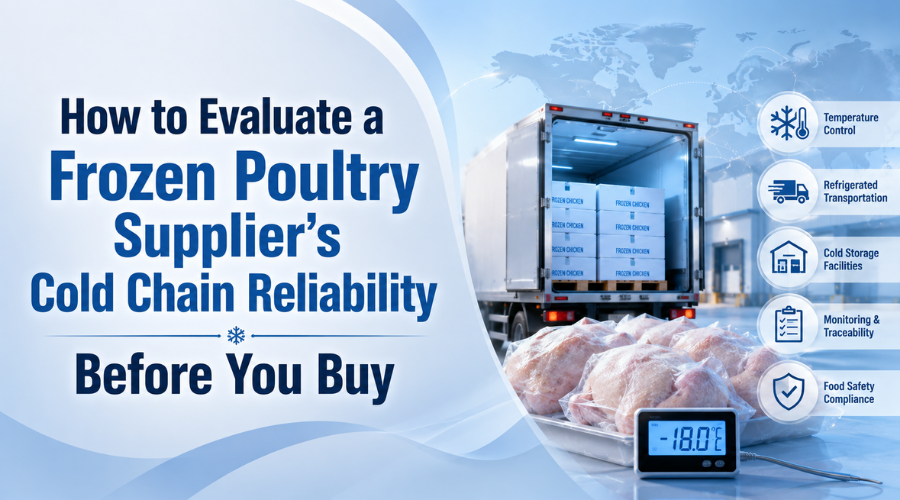
The first step of assessing a frozen chicken leg sourcing partner is to inspect their temperature logs, storage certificates, and transport vehicles. Even with proper packaging, product loss can occur due to cold chain breaks and bacterial growth. A quality bulk frozen poultry leg supplier keeps records for each step from processing to delivery.
A cold chain drop from the plant to the dock can happen anywhere once the poultry is frozen and ready to ship. Excessive heat during storage or transit causes loss of texture, spoilage, and bacterial growth. This guide shares a step-by-step process for making cold chain reliability a part of purchase ordering activities.
Bacterial growth can still occur when the cold chain breaks in frozen products. If poultry is kept above -18°C for a significant length of time, it may thaw enough at the surface for any pathogens to start growing when it freezes again. This can happen even though the product appears completely frozen when it is delivered. One high-temperature event, even reaching 30–60 minutes, can cause a loss of texture and reduce the shelf life by several weeks. Don't rely only on the delivery temperature; ask any frozen chicken leg sourcing partner whether they've maintained continuous temperature control.
Frozen poultry legs should be kept at or below -,18°C during storage and transport. For longer shelf life and export orders with longer shipping times, some suppliers keep products at -20°C to -23°C. Check with your supplier on their normal storage temperature and how frequently they record it. Automated sensors record warehouse temperatures reliably, rather than relying on spot checks per shift.
Request sample temperature logs, covering at least one storage cycle from processing to storage, including continuous data without gaps between shifts or weekends. Level changes often indicate missing monitoring. Modern cold storage is equipped with IoT-based sensors with auto-alerts if the temperature exceeds a set value, such as -15°C. Find out whether your bulk frozen poultry leg provider uses an automated alert system or manual checks; automated systems detect problems earlier.
Certifications will certify that the supplier meets recognized food safety standards when handling frozen products. Without certificates, contamination and customs delays are more likely. Before placing a bulk order, check for these.
· Hazard Analysis Critical Control Point (HACCP) for food safety process control
· BRCGS (Brand Reputation through Compliance) certification of storage and handling criteria
· ISO 22000 for food safety management systems
· Halal or Kosher certification, if needed for your target market.
· A veterinary health certificate demonstrating compliance of poultry sourcing and processing.
Certifications are normally renewed every 1-3 years. As a rule, always make sure you get the latest certificate issued with a proper expiration date before ordering in bulk.
Reefer trucks and containers are maintained at -18 °C or colder in transit and monitored by the data logger attached to the reefer at shipment. Ask your supplier who they use to coordinate the shippers and who they share real-time GPS and temperature data with. When shipping overseas, make sure that there is a calibrated temperature recorder that has been verified and certified within a year. An uncalibrated recorder could give an incorrect reading and could make it hard to capture a real cold chain failure over a few weeks' ocean voyage.
Don't take general assurances about quality; ask specific questions! A trustworthy frozen chicken leg sourcing partner won't hesitate to answer these questions and will provide documentation upon request.
· How frequently is warehouse temperature measured, and could you provide logs?
· What happens when a temperature excursion is detected in-transit?
· What are your current certifications, and do you have current copies to show?
· How many days before delivery is product kept in cold storage?
· Do you use third-party cold chain auditors, and how often?
Suppliers who avoid these questions or answer them vaguely are at greater risk of future cold chain problems.
Before placing a large order, ask to see a video or walk-through of the cold storage facility. Verify uniformity of frost patterns, which may indicate temperature cycling rather than stable storage. Excessive frost on packages can indicate multiple freeze-thaw conditions. Third-party audits, such as with SGS or Bureau Veritas, can be conducted at your facilities. In general, audits will cost $300-$800 based on facility size and location and are a worthwhile investment for your initial order of $20,000 or more.
Generally, the minimum order quantity for frozen poultry legs is 5-10 metric tons per order. The MOQ for custom packaging orders or private label orders is generally 15-20 metric tons. Some suppliers will allow a small trial order of about 1-2 metric tons for new buyers to check quality and reliability. Lead time is typically 15-25 days following order confirmation.
Packaging is directly involved in maintaining product temperature. Vacuum-sealed poly packs reduce air exposure and ice crystal formation compared with loose packaging. Master cartons should be cold-rated, usually wax-coated or moisture-resistant corrugated. Verify carton stacking height and pallet form units, as overloaded pallets inhibit airflow in cold storage and can create cold and hot spots within each load on a pallet. Request standard carton weight (typically 20kg) and dimensions (typically 40 x 30 x 25 cm) for poultry legs.
Depending on the severity of a cold chain issue, there may be indicators that alert you to a problem before laboratory testing. Check for excessive crystals on the sidewalls of the packaging, which can indicate thaw-refreeze cycling. Any discoloration, freezer burn, or odor when thawing is also a sign of temperature abuse in storage or transit. The temperatures of different deliveries from the same supplier vary; this means the process is not in control. Record temperatures for each delivery and mark any above–15 °C to identify recurring issues and consider switching suppliers.
Demand is high, such as a high requirement for cold storage capacity during peak demand periods, such as holidays. If warehouses are running close to capacity, the airflow through them is likely to be turbulent, possibly creating "hot spots" within storage rooms. Inquire whether your supplier has capacity during the peak season.
Ask whether your bulk frozen poultry leg provider has a separate holding area during peak season for customers who want to buy poultry from a bulk supplier. Suppliers may not reserve capacity, which can lead to your order being deprioritized. This might increase the time it spends in the auction house buffer, depending on overflow storage capacity.
Traceability systems track every delivery, its processing and batch, and its storage history. This is important because it enables you to identify exactly where a cold chain break occurred in the event of a quality issue after shipment. Request batch-level traceability documents with each delivery.
A good supplier should keep the product traceable on the processing floor to its last delivery by barcode or RFID. This data should include timestamps for each cold storage transfer, giving you a full paper trail if a temperature dispute or product complaint comes up later.
Assessing cold chain reliability before purchase helps prevent losses and food safety issues for your business. Review temperature logs, certifications, and product monitoring before placing a bulk order. Give specific requests and inquiries; especially when making a large first order, ask for a facility audit. Once you've got these things working, you will create a quality-assured product and a repetitive delivery arrangement with a frozen poultry supplier.
How many degrees should frozen chicken legs be stored at?
During storage and transport, frozen chicken legs must be maintained at or below -18°C. For export orders, some suppliers may store them at -20°C – -23°C for extended shelf life.
How do I check the reliability of cold chains before placing a bulk order?
Ask for temperature logs, certifications (HACCP and BRCGS), and facility audit. Check with specific questions about how often and where it will be monitored.
What is the lowest possible order size for bulk frozen poultry legs?
The minimum order quantity (MOQ) is generally rounded up to 5-10 metric tons for ordinary cuts. Custom packs or private-label orders usually require 15-20 metric tons.
What are my options if a temperature excursion is noted post-delivery?
Save documentation of the reading in photos and your data recorder report, then inform your supplier right away. Reliable suppliers conduct a thorough investigation and develop a corrective action plan for future shipments.
Highlights • A wood pell
READ FULLHighlights The first step of
READ FULLWood pellets are an evergreen fuel for boilers, even in this state-of-the-art world. People use a
READ FULL