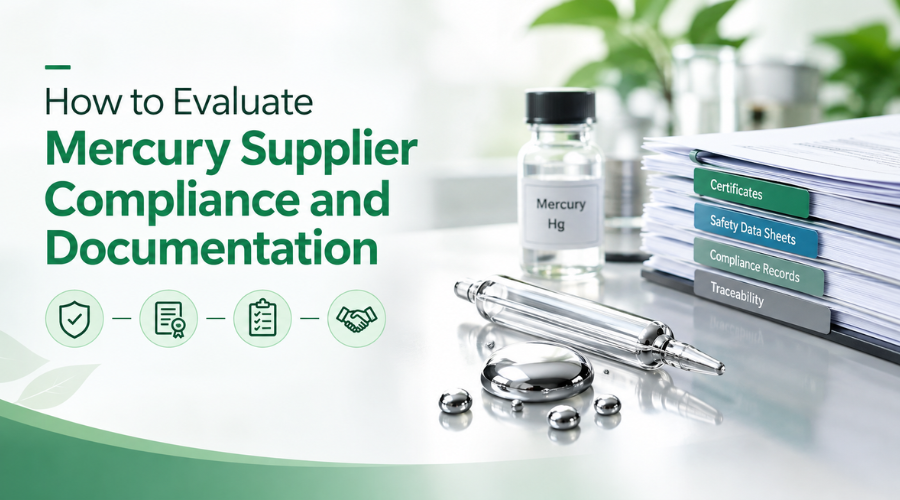
Mercury is among those elements that are not safe for any living organism at all. It is even prohibited in many countries, and only a few authorized suppliers can supply it. There are many restrictions on it, and it requires suppliers to comply with complex documents only to qualify for global trade. Buying silver liquid mercury wholesale, even for industrial applications, is not as simple as any other commodity. One has to find suppliers that have legal authority to supply this sensitive material. Someone who is about to procure liquid mercury needs this guide to select only legitimate suppliers in the world. These are certified suppliers with every document that backs them for the international trade of such sensitive material.
When sourcing mercury, you will have to ask for some documents that will ensure legality. Unless a supplier provides these documents, you can not proceed to the next step. Here is detailed information you need when sourcing liquid mercury.
The CoA is the primary document one needs when supplying such a sensitive commodity. It shows the details regarding the purity of red mercury. Since the purity level goes from 99% to 99.999%, this document becomes mandatory in silver liquid mercury wholesale supply. It provides information through a third-party testing process, which is a sign of trusted quality. The same document provides impurity traces, such as contaminants and heavy metals present in the mercury. The details also include the CAS number, batch number, and similar details that define the unique identity of mercury.
Sourcing mercury requires another document, which is a certificate of compliance. Since there is a requirement regarding Compliance with the Minamata Convention in the trade of mercury, it is mandatory to follow. The supplier must have this document, which describes the safety of mercury in terms of emissions into the air and its reaction with water, although it is insoluble. Mercury has lethal effects on living organisms, which is why this compliance is a must for the supplier.
Even the storage, handling, hazards, and every related element of mercury are essential. To ensure they all comply with the safety standards, the supplier has to provide an SDS (Safety Data Sheet) along with SGS certification. These documents are mandatory at the time of supplier evaluation because if a supplier can not provide them, you can not proceed with that supplier.
A similar document is also mandatory, and it is the Dangerous Goods Declaration certificate. It ensures that mercury is secure, marked, and labeled with sealed packaging. This is totally about the storage requirements of such a sensitive element in the shipping process. It also mentions the class of mercury since there are multiple types for different applications. Each class has a unique nature, which requires special arrangements.
This document is required from the buyer about the legitimacy of the purchase and the purpose of use. The supplier demands this certificate from a buyer, and it may contain information regarding the industrial use. Liquid mercury is used in gold and silver extraction, along with the production of electrical switches, fluorescent bulbs, thermometers, and thermostats. So, if a supplier is authentic, they will surely ask for this document from buyers.
Another document that a buyer needs to demand from the supplier is the hazardous material manifest. It contains all the details, like the chain of custody during transit. It basically provides details about all the steps, from origin to destination, for the traceability of mercury.
Continuing the above section, traceability is important for the authentication process. It ensures that the supplier is a genuine manufacturer instead of a trader who is pretending to be a manufacturer. Also, it helps recognize the grade and class of mercury along with purity level. If a supplier can share details like traceability, you can go ahead with the procurement process. But here are some additional elements you need to see in the following sections.
The lot number and batch information provide the consistency of mercury’s quality. If a manufacturer has used the same source, there will be consistency in the quality. The grade will be the same in all the lots, which will lead to desired results for buyers in their application. A supplier who can provide batch information can prove its authenticity and reliability for the procurement process.
You need to focus also on this last step, which ensures a supplier meets all the safety measures. Mercury is a sensitive and lethal material, which surely needs sealed packaging. That packaging has to be in the form of stainless-steel flasks that are completely sealed. It is mandatory because not doing so will cause failure to comply with International Maritime Hazardous Material standards. It covers all the elements like storage conditions and shelf life of mercury.
Any risk of leakage can cause severe contamination of the air and whatever is in the surroundings. Mercury’s tiny particles can seep through the nostrils and can cause lung cancer. That is how sensitive this matter is.
A highly sensitive material like mercury requires due diligence for overseas trade. When procuring it from a supplier, one has to ensure that the selected supplier meets all the safety requirements. These requirements are about the purity of mercury, traceability, class, packaging, reactivity, and many other elements. If you are a buyer, you will have to ask for a list of documents from your supplier to make sure it can qualify for the process. Global safety compliance is mandatory, and only a genuine supplier can complete all the documents to supply mercury worldwide.
Which Export Documents Must Every Supplier Provide When Supplying Silver Liquid Mercury Wholesale?
These documents are the Certificate of Compliance, Dangerous Goods Declaration, Certificate of Analysis, and Safety Data Sheet. Also, export documents, a business license, and a Hazardous Material Manifest are among them. A supplier has to provide these key documents to prove the purity of mercury
Is Export of Mercury Prohibited, and Where Can I Procure It Legally?
Yes, it is prohibited because of various safety concerns. Countries or companies that export it have to comply with the Minamata Convention and some other safety standards. The restrictions are too high, which is why one has to find only a globally compliant supplier.
Why is a Certificate of Compliance Mandatory When Sourcing Silver Liquid Mercury Wholesale?
It is mandatory for the sake of environmental, human, and animal life protection. Mercury is a lethal material that can emit tiny particles into the air, which can enter the lungs and cause lung cancer. There are many other consequences, which is why a special license is provided only to specific exporters. Weiss Green Inc. is also a supplier of silver liquid mercury. You can contact it for documentation for the procurement process.
What is the Purpose of Safety Data Sheet in Exporting Silver Liquid Mercury?
This document contains all the instructions regarding the storage, handling, hazards, and precautions for handling mercury. SDS provides all essential information a buyer needs.
Mercury is among those elements that are not safe for any living org
READ FULLHighlights • A wood pell
READ FULLHighlights The first step of
READ FULL